



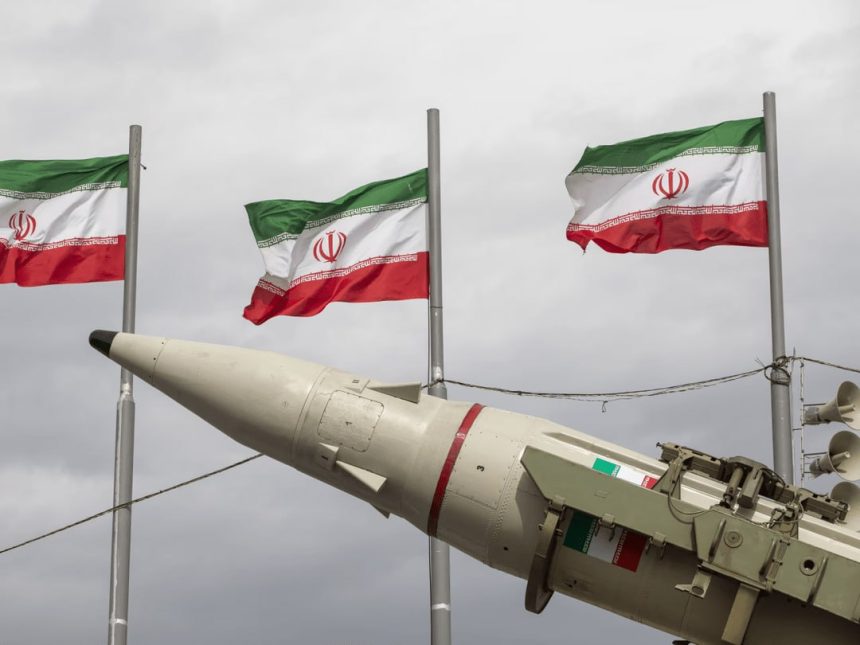
When military planners speak of long-range strikes let’s say from Tehran to Kampala, a distance of roughly 5,000 kilometres ,the question that often arises outside defence circles is disarmingly simple, how does it stay in the air and it still knows exactly where it’s going?
It is a fair question. After all, the journey stretches across vast distances, changing atmospheric conditions and even the subtle movement of the Earth itself.
Yet modern missiles do not wander through the sky hoping to stumble upon their target. From the moment they leave the ground, they are guided by a quiet but relentless logic; they always know where they are.
The story begins long before launch. By the time a missile is rolled out and prepared for firing, its entire mission has already been mapped in precise detail.
Engineers and planners feed it exact coordinates, the point it will depart from and the exact location it is meant to reach. Between those two points lies a carefully calculated path shaped by physics, geography and timing.
Once launched, the missile does not rely on a human operator guiding it from afar as one might steer a drone.
Instead, it flies on its own. It carries within it a self-contained navigation system, effectively its “brain,” allowing it to make decisions in real time.
At the heart of this system is what defence experts refer to as inertial navigation. Though the term sounds technical, the idea is straightforward.
Inside the missile are tiny, highly sensitive instruments that measure motion and orientation. Some track how fast the missile is accelerating, others detect how it is turning or tilting in flight.
By constantly adding up these movements from the moment of launch, the missile builds a continuous picture of its own position.
In practical terms, it does not need to see Kampala or any other destination. It simply keeps track of itself where it started, how far it has travelled and in which direction.
From that, it always knows, within a small margin of error, where it is.
But the journey is far from smooth. Over thousands of kilometres, even the smallest disturbance matters. Winds at high altitude can push the missile off course. Variations in engine performance can introduce slight deviations.
Even the Earth’s rotation subtly alters the path.
This is where the missile’s ability to correct itself becomes critical.
Much like the autopilot of a modern aircraft, it continuously checks whether it has drifted from its intended path. When it detects even a minor deviation, it adjusts nudging itself back on course using small control surfaces or changes in thrust.
These corrections happen constantly, often many times each second, over the entire duration of the flight.
To improve accuracy further, modern systems rarely rely on one method alone.
Satellite navigation, similar to the GPS used in everyday devices can provide periodic updates to refine the missile’s position.
Some systems compare the terrain below with preloaded maps effectively matching what they expect to see with what lies beneath them.
Others, particularly in longer-range systems, even use the stars as reference points much like ancient navigators at sea.
As the missile closes in on its destination, it enters what is known as the terminal phase ,the final stretch where precision matters most.
Depending on its design, it may switch to onboard sensors such as radar or infrared to refine its aim. In other cases, it simply follows its calculated path to the very end trusting the accuracy built up over the course of the journey.
The result is a system that despite travelling thousands of kilometres, does not lose its way. It is not guessing, nor is it searching blindly. It is calculating relentlessly and continuously from the first second of flight to the last.
In intelligence terms, a long-range missile is less a simple weapon and more a self-contained navigation platform.
It carries a pre-programmed route, a system that tracks its own movement and the ability to correct itself whenever it strays. In that sense, it behaves less like a projectile and more like a pilotless aircraft, one that never forgets where it came from and never loses sight of where it is going.
In the end, A missile does not wander through the sky hoping to find its target. It follows a plan, keeps track of its movement and makes constant adjustments until it reaches its destination.